
The Budget Isn't Finished When You Adopt It
The Budget Isn't Finished When You Adopt It
There is a particular kind of relief in the room after a budget vote passes. The workshops are over, the hard conversations are done, and the packet goes in a drawer until next September.
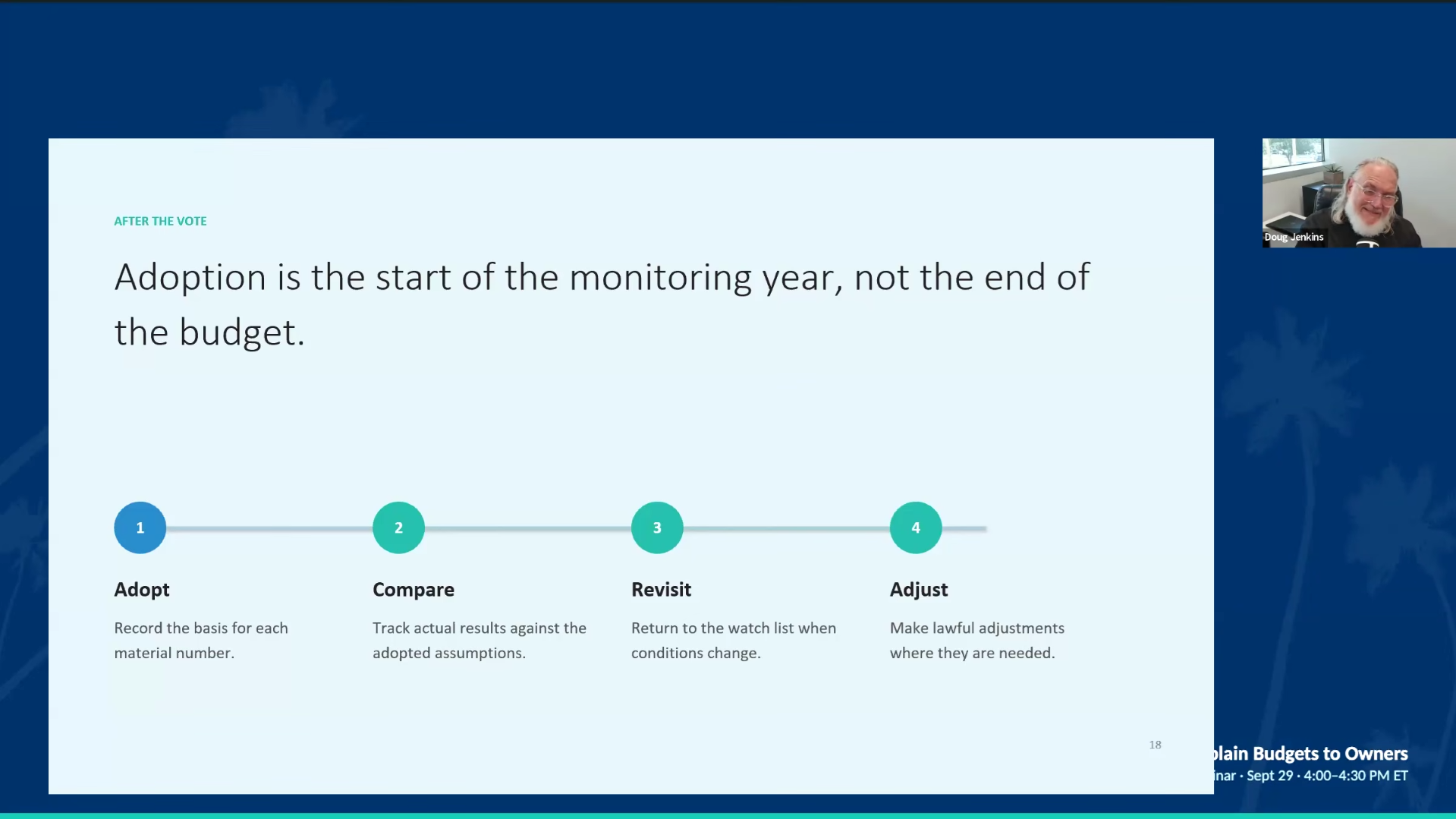
But as Doug Jenkins explains in his board education session, adoption is the start of the monitoring year, not the end of the budget.
A budget is a plan built on assumptions. Some will hold. Others will change as the year unfolds. The board’s responsibility does not end when the vote passes. It continues through the decisions that follow.
What the Vote Actually Settled
A budget is a set of decisions made before all the facts are available. Adopting it does not guarantee that every assumption will prove correct. It commits the association to a plan based on the information available at the time.
Then the year happens.
An insurance renewal arrives at a different amount than expected. A vendor reprices a service. A repair that was supposed to wait becomes urgent.
These changes do not necessarily mean the budget was poorly prepared. They are part of managing a community over time. The important question is whether the board is monitoring the plan closely enough to recognize changes while it still has options.
Three Things to Put in Place Before January
A few simple steps at adoption can make the budget easier to manage throughout the year.
1. Record the Basis for Each Material Number
Document the reasoning behind significant budget figures while it is still fresh.
Was the amount based on a signed contract, recent experience, or a placeholder because final information was not yet available? If it was a placeholder, what assumption supported it?
Recording this information at adoption helps the board understand what it approved. Without that context, directors may find themselves trying to reconstruct the reasoning months later.
2. Identify the Assumptions Carrying the Most Risk
Not every budget line has the same potential impact. Identify the two or three assumptions where an unexpected change could create the most difficulty for the association.
These might include insurance, major vendor contracts, utilities, or a significant repair. The specific items will depend on the community.
Name those assumptions during the budget discussion and include them in the meeting record. This gives the board a clear starting point for monitoring.
3. Schedule a Mid-Year Review
Put a short budget check on the calendar before the year gets too far along.
The review does not need to become a full reforecast or a lengthy special project. A focused agenda item can give the board time to compare its key assumptions with actual expenses and updated information.
The goal is to notice meaningful changes early, not to revisit every line item.
Why Mid-Year Is When Options Still Exist
A shortfall identified early in the year may leave the board with several ways to respond. Depending on the circumstances, the association may be able to adjust project timing, discuss contract terms, revisit planned spending, or communicate with owners before the issue becomes urgent.
A shortfall discovered near the end of the year can leave fewer practical choices and less time to explain the situation.
The difference is not necessarily the quality of the original budget. It is whether the board checked the plan while there was still time to act.
Budget Monitoring Helps Board Knowledge Survive Turnover
Directors change. The people who adopted the budget may not be the same people managing its consequences several months later.
A budget packet that records the basis for material figures and identifies the assumptions worth watching gives future directors useful context. They can see not only what the association planned to spend, but why those amounts were chosen and where uncertainty remained.
Without that record, each new board may inherit a spreadsheet without the reasoning behind it. Documenting the decisions helps preserve institutional knowledge and gives the next board a clearer starting point.
Make It a Short Agenda Item, Not a New Project
A practical monitoring process does not have to require a new committee or a complicated reporting framework.
Start with three actions:
- Record the basis for significant budget figures when the budget is adopted.
- Identify the assumptions that carry the most risk.
- Schedule one focused review to compare those assumptions with actual numbers.
That is enough to make the budget a plan the board continues to manage, rather than a document it approves and sets aside.
Watch the Full Webinar With Doug Jenkins
In Judgment, Not Arithmetic, Doug Jenkins of Association Training Hub walks through five questions that help boards build and monitor a budget with greater clarity. The CAM Team sponsored the session to support informed budget discussions and practical decision-making throughout the year.
Need Help Planning a Mid-Year Budget Check?
The CAM Team can help your board establish a focused review process that fits your community’s budget, priorities, and meeting schedule. Reach out The CAM Team to learn more.